Saturday, 19 May 2012

The Public Baths


“I have a bath, twice a year, whether I need it or not,” runs the old joke, but the Victorians’ concern for cleanliness soon encouraged the creation of public bathing facilities.  In those days of overcrowded working-class housing, toilet facilities were shared, external and had little or no privacy; bathrooms were a mere fantasy!  One of the city’s early public baths which had the addition of a ‘swimming pond’ in 1869 was that established in Crooked Lane in 1851.

The earliest mention of public bathing was at the Beach.  Alexander Mowat was the owner of sea-water baths at both the Sea-Beach and the Quay, and in 1845, the well-heeled bather would pay £10/6 shillings a season for use of the facilities.

The Crooked Lane site was run originally by Archibald Grant, and the secretary was local advocate and insurance agent, D. G. Cattanach.  Mr Mowat and his partner, Alexander Mackie still ran their facilities until 1867 at the Beach and Regent Quay, the latter doubtless catering for grubby sailors disembarking from merchant ships.

1867 OS Map of Aberdeen showing the Baths in St Andrew Street/ Crooked Lane

Modesty was clearly preserved at the Aberdeen Public Baths, as a ‘female entry’ was advertised as being from 40 St Andrew Street.  Ladies could attend to their ‘toilette’ without the fear of any gentlemen spotting them in a state of undress!  

When James Angus took over as superintendent of the baths, he advertised his facilities in the Post Office directory.  In 1857, a first class hot bath or shower would cost one shilling, but if you were a bit short on cash, and liked a brisk cold dip, it would only set you back 1 old penny; salt was 3d extra!  Later superintendents, like Donald McKay (from 1862) only felt it necessary to advertise the opening times, which were from 6am to 9.30pm, daily.  His successor, William Cameron, amended Sunday openings to just 90 minutes from 7am, presumably so as not to disturb local churchgoers.

The Crooked Lane Baths closed in 1887, and transferred to larger premises at Constitution Street.  This was superseded in 1898 by the Beach Bathing Station.  Many folk would still not have baths at home even by the time the Uptown Baths opened in 1940.  Swimming is still very popular in the city, and a new pool or ‘aquatics centre’ is slowly rising from the ashes of Linksfield Academy on King Street, but the days of public bath houses have gone forever.

Thursday, 5 April 2012

Road to the Gallows


The swinging Sixties; the Profumo Scandal showed morals were on the decline.  But in 1963, Aberdeen had its own case of fatal attraction which would lead, for one man, directly to the execution chamber.

Henry John Burnett – the last man hanged in Scotland – had an affair with a married woman.  In a fit of jealous rage he shot dead her estranged husband in her mother’s house in Jackson Terrace.  Harry would later tell a constable who looked after him at his trial that he had given Thomas Guyan ‘both barrels’.  His escape route out of the house towards a garage in Seaforth Road, where he would commandeer a car, with his paramour, Margaret, had a chilling significance for his eventual fate.

Rewind to 17th century Aberdeen, and Parson James Gordon’s fascinating illustrated map of the city.  There were two routes north in those days, one through ‘Aberdon’, part of Kings College’s university town and the other via the links, which passed by the Gibbet.  Situated on a lonely hillock opposite the Broad Hill, the ‘hanging tree’ stood as a warning to all.  Often there would be the gruesome skeleton of the last criminal executed there, swinging in the breeze, its empty eye sockets terrifying any traveller on the route.


Today the Gallows Hill, as mentioned previously in this blog, stands at the top of Errol Street by Trinity Cemetery; that medieval route north now follows Park Road and crosses Urquhart Road at Urquhart Lane.  Did it occur to the fleeing Harry Burnett, three centuries later, that he was within sight of the ancient place of execution? Urquhart Lane passes directly by the corner of Jackson Terrace and the house where the murder took place.

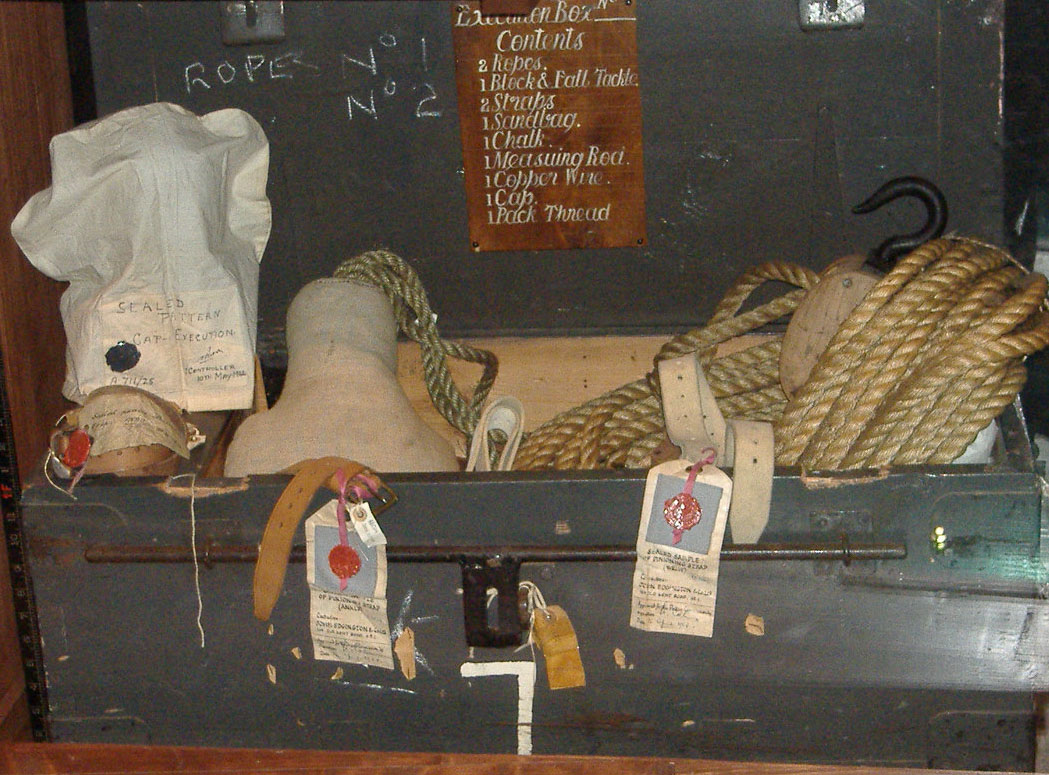
Executioner's kit - gruesome legacy of capital punishment
In August 1963, Harry would be the only man to face execution in Aberdeen since John Booth had been hanged at the Castlegate in 1857.  The former’s death took place in the privacy of Craiginches Prison, the only time the execution suite was used before the abolition of the death penalty in 1969.

The significance of the old Gallows’ road may indeed have eventually dawned on Harry, as a retired policeman recalled his anguished words when leaving the dock a condemned killer, ‘I’m goin’ tae hang!’

Urquhart Lane, an anonymous street of garages has witnessed many on that long final road, perhaps none more tragic than Harry Burnett, the fair-haired lad who didn’t intend to kill.

Thursday, 1 March 2012

Skipper Scott and Prince Jamie


Peacock Close - c.1900

Most folk in Aberdeen have heard the name Peacock Court, either because of a local art studio or the city’s first dancing master, Francis Peacock after whom the lane is named.  The next one off Castlegate is Peacock Close, its old name, however, was Skipper Scott’s Close.

‘Skipper’ Alexander Scott was a Jacobite, a supporter of the exiled Catholic dynasty of Britain.  It would be he who gave hospitality to the ‘highest Stuart o them aa’ on a dank, foggy night two days before Christmas 1715.  Scott was a ship owner and lived in the large tenement which stretched all the way back to what was then a great expanse called the King’s Meadow; now East North Street.  He and fellow Jacobites including George Keith, the 10th Earl Marischal, were delighted and honoured to receive ‘The Old Pretender’ aka Prince James Edward Stuart, to the city.

However, by November of that year, the Prince’s army, led by his deputy, John Erskine, the Earl of Mar, had been defeated at Sheriffmuir.  It seemed James’ cause was lost before he even arrived.  Neighbours of Skipper Scott reported seeing three men on horseback, dressed in French naval officers’ uniforms arrive outside the close late on the 23rd of December.  The skipper was seen to bow to one of his guests as they dismounted.  Jacobites all knew this was their future king, who at the time was suffering from a cold and had only arrived in Scotland the previous night.  Alexander probably gave the prince a king-sized feed and sent him to rest with a wee dram.  Of course, the 1715 Rebellion failed miserably and James Stuart left in February 1716 from Montrose, never to return.

Door lintel showing Alexander Scott and Janet Kinear's initials

Very recently, I took a wander up Peacock Close and discovered a very interesting sight:  On the left wall halfway down the close, you will find a lintel stone with two sets of initials: AS, IK and the date 1710.  Parish records reveal the marriage of Alexander Scott and Janet Kinear in 1696.  Could the ‘I’ be a ‘J’ which was not uncommon in late medieval script?  If so, then the couple moved in five years before Prince Jamie came to call, and perhaps it was Mrs Janet Scott who brought the ‘uisge beatha’ for His Royal Highness to drink almost three centuries ago.

Monday, 6 February 2012

The Torry Coo that Doesn't Moo


The Torry Coo is not a bovine, but the foghorn situated below Girdleness Lighthouse on Greyhope Road.  Sadly the horn has not sounded since the late 1980s, as it and all others in Scotland were shut off by the Northern Lighthouse Board, modern ships thought to be too large and enclosed for the captain to hear a fog signal.  However, there are still signals near some Scottish lighthouses, and in the south of England, ‘fog cows’ regularly bellow as the mist envelops the coast.

But our ‘Coo’ was completed in 1902, replacing an earlier fog signal east of the present site.  The ‘moo’ was ingeniously created by means of 25bph oil-fired engines which produced compressed air, then forced it through a rotating siren.  The large tanks on the fog horn stored the air as the ‘Coo’ sounded her warning to ships.  The lighthouse and fog signal were introduced to patrol Greyhope Bay as a result of the terrible sinking of the Oscar, a whaling ship which ran aground in a storm in 1813, with the loss of 42 lives.  However, it would be another twenty years before these safeguards were in place and the Stevenson-designed lighthouse was opened in 1833.

It was a Scot who invented the automated fog signal after centuries where only a bell was used (Aberdeen’s fog bell can still be seen near the new Marine Operations centre in Fittie).  Robert Foulis, who had emigrated to Canada, heard his daughter’s piano playing as he returned home on a foggy night and noticed the low notes carried further.  He built a steam-powered device which sounded sonorous bass notes and it was installed on Partridge Island, New Brunswick in 1859.

The sound of our Torry Coo not only resembled the bovine braying, but to a legendary sea monster that lived in Greyhope Bay it sounded just like a male of her species.  The story goes that she cried back to the fog horn’s sound, thinking it was a potential mate, yet was eternally disappointed as although she heard the returning call, she could never find her handsome male monster!  The echoes of the fog signal out at sea were apparently the lady monster’s anguished utterances, until of course, the Coo was silenced forever.

Ships today are full of technical wizardry which have made the Coo and her ‘herd’ obsolete, but you never know when we will need them again!

Thursday, 19 January 2012

The Last Tram Line


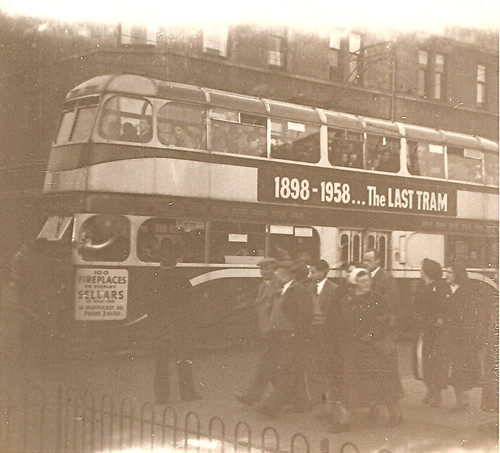
In the dead of night on a May evening in 1958, few of the residents of Constitution Street would have heard the rumble of the entire fleet of Aberdeen’s trams, destined for their funeral pyre on what was left of the old Sea Beach line.  Those that did rouse themselves and attend the almost arcane end to what had once been the city’s main form of public transport would have seen the first twenty cars bump along the track and draw up in two rows before being doused in paraffin and set alight.  All that remains of that sad day for tram enthusiasts are the forlorn steel rails which can be found on the Links near the Beach Boulevard.  Wander along there today and you might notice the churned up tarmac — could it contain charred fragments of those wonderful trams?

Aberdeen’s very first horse-drawn tram appeared in August 1874, two years after the Aberdeen District Tramway Company was set up by local businessmen.  The first routes ran from King Street to Queen’s Cross depot and St. Nicholas Street to Kittybrewster Central Park, later the site of the Astoria cinema.  When ‘horse fuel’ got more expensive, the need for electric trams, first proposed in 1896, prompted the council to make a public takeover of the tram company and fund the installation of the necessary equipment for the princely sum of £103,785.  The private enterprise had already carried over 60 million passengers in the 24 years of its existence.


The Corporation Tramways increased the routes, added more cars, and started operating on Sundays – a popular decision with the citizens!  Sadly the glory days of the trams were already over by the 1920s when motor buses were seen as the economic alternative which could more easily serve the city’s transport needs.

In 1958 the council finally decided trams were ‘at the back o’ a day’ and sold the lot for scrap to Bird’s of Stratford-upon-Avon.  After an earlier gala procession, the trams’ very last journey was a greater spectacle to behold.  Like the Viking galley of Shetland’s Up-Helly-Aa, the entire rolling stock blazed up into the spring night, leaving a mangled heap of blackened metal in the cold light of the following day.

The tram lines are all that remain.  Stand there sometime; maybe you will hear those wheels rumbling on their ghostly way down the track as they did 54 years ago.

clack...clack...clack...

Saturday, 31 December 2011

The Bones of St Nicholas Part II


In October I stood on the oldest known floor in Aberdeen, a true ‘hidden’ gem as the above image shows.  It belongs to the Kirk of St Nicholas. How old?  Around a thousand years according to the carbon dating of the graves discovered in the recent dig.  The fish-rich diet of our forebears skews the results of the dating, changing the mineral content of those old bones, but certainly some time during the 11th century.

So why build a stone church in a small, Scottish coastal settlement in 1000AD?

David I's seal
By the 1100s, Aberdeen had the status of a royal burgh, granted by David I.  David also invited Bishop Nechtan of Mortlach to settle here and make it the centre of the new bishopric in 1124.  The fact Nechtan and his successors concentrated their efforts on building a cathedral in Old Aberdeen, then Villa Aberdon, rather than in the centre of the burgh, suggests there was a considerable church here already.   The 1157 ‘bull’ or charter from Pope Adrian IV to succeeding bishop, Edward, refers to churches in both burgh and ‘villa’.

But why was the bishopric not founded there in the first place? What was the significance of Mortlach?  Despite the romantic notion it was founded in 1012 after the Danes were defeated there by Malcolm II, modern historian, Alex Woolf believes that the actual founder was the former’s great-grandson, Malcolm Canmore, in 1065.

Malcolm Canmore
This Malcolm is better known to us as the hero of Shakespeare’s infamous ‘Scottish Play’, when he returns to slay the murderous Macbeth.  However, the English playwright’s grasp of Scottish history was practically zero.  Macbeth had a perfectly legitimate claim to the Scottish throne; whereas Malcolm’s family had spent the last three generations bumping off their enemies to gain the prize.

Mortlach, located near modern-day Dufftown, was in the ancient Pictish state of Moray, Macbeth’s territory.  Malcolm founded the bishopric here out of political necessity rather than religious fervour, so the churchmen could keep order amongst Macbeth’s supporters and allies, natural enemies of the new king.

Perhaps Malcolm felt a little guilty after all and decided to fund the building of a new church as a means of atonement for his bloody deeds.  Aberdeen profited.  Whatever the case, the bishopric of Mortlach was instituted just at the time Alexander Gammie suggested that the kirk of St Nicholas was begun.  Only time … and archaeology will tell!

Friday, 30 December 2011

The Bones of St Nicholas Part I


No, no, not the relics of the Bishop of Myra who became the most famous patron saint of children … no, it is the mortal remains of our Celtic forebears who named their settlement Aber Da Abhainn, ‘At the mouth of two rivers’, the Dee and the Denburn, to which I refer in my title.

These bones were discovered by local archaeologist Alison Cameron back in 2008; the burial of twenty-three skeletons of infants and children were revealed outside the curved wall or apse of the earliest known stone church in Aberdeen.

Received wisdom stated that the ‘Great Church’ dedicated to St Nicholas which appears prominently on Parson Gordon’s 1661 map was founded in the twelfth century. Imagine Alison’s surprise at the ‘extraordinary’ result of the carbon dating on the children’s graves which placed them in the period between 890 and 1020AD!  This was history in the making – confounding centuries of previously accepted knowledge.

The burials apparently could not have predated the church building as they are laid out to follow the curved wall in a fan-shape, and they were undamaged unlike later burials above.  Therefore that Celtic community on the upper slopes of the Denburn Valley was in existence more than a century before chieftain, Gillecoaim, who gave his name to Gilcomston, witnessed the royal charter granted to the monks of Deer in 1152.

Aberdeen Civic Seal from 1150-1424
showing Nicholas with nautical symbols
These Celts, who spoke a tongue closer to Welsh than Gaelic, were fisherfolk who exploited the rich harvests of salmon in the rivers and white fish in the North Sea.  It is no surprise then that they should choose ‘Blessed Nicholas’ in his aspect as patron saint of seafarers as their spiritual protector.

The Christian faith of these fishers would have been rooted in the mission work of early wandering preachers like Saints Machar, Ternan and Molaug who came to NE Scotland in the 5th and 6th centuries.  Aberdeen did not become a bishopric until 1124AD, but was moved from Mortlach in Banffshire, a religious centre from the 1060s.

Oddly enough, the only person to ever suggest an earlier date for the building of St Nicholas’ kirk was historian Alexander Gammie, who gives the date 1060AD in his Churches of Aberdeen, published in 1909.  Those little graves of the ‘Mither Kirk’, hidden for so long, now tell us that he and those medieval chroniclers, dismissed by modern historians, might have been closer to the truth all along.
St Nicholas, Bishop of Myra