Friday, 21 June 2013

The Denburn Valley – 10,000 Years of Occupation


Looking down over Denburn Road from Union Bridge up towards Woolmanhill Hospital, it is difficult to imagine that once this area consisted of tall, grassy riverbanks, a wide, flowing river and a vast loch stretching across one hundred acres between Skene Square, Spring Garden, Loch Street, St. Andrew Street and Woolmanhill.  Yet this was the Denburn Valley at the end of the last Ice Age, and archaeological evidence tells us that our hunter-gatherer ancestors made seasonal camps here.  Wild boar, deer, bears, wolves, all roamed freely and some were likely to end up skewered by a hunter’s arrow to feed his family.

The identification of a Neolithic burial cairn on what is now Hill Street demonstrated to medieval residents that farmers had settled on the site from c.4,000BC.  The cairn was only removed in 1780 when the Boys’ Industrial School, the forerunner of Oakbank, was built.  For another century, two obelisks, known as the “Stones of Gilcom” remained in the school’s exercise ground until the site was cleared for tenements. 


Pre-industrial settlers were known to harvest the seagulls and geese which nested on the loch banks for food; indeed Spring Garden was named for its fertile ground in which vegetables were grown.  But by the 1630s, a council report showed that the water was “filthy, corrupt and defilet by folk again washing clothes, waste water draining from the gutters and other sorts of uncleanness”.  It would be 1706 before a plan was mooted to provide the city with a cleaner supply directly from Carden Haugh spring which flowed up from the Denburn near Cherrybank mansion – today, the car park of Carden Place Medical Centre. 

The last portion of the valley before the Denburn flowed out into the Dee had become a popular spot for bleaching linen, used mainly by the residents of Mutton Brae, the community situated on the slopes below Belmont Street and the Triple Kirks.  The Corbie Haugh (Crow’s Hollow) on the far bank featured the Corbie Well which provided refreshment for the washerwomen as they pegged out their sheets on the grass.  The coming of the railway however would do away with this leafy spot.  The new single track from Kittybrewster was laid out in 1867, which connected Aberdeen with the Highlands, by then patronised by royalty.  The council realised that they should beautify the old valley to make an attractive approach to the new Joint Station, thus plans were drawn up for an ornamental garden terminating at Union Bridge, in situ since 1803.  The “Denburn Gardens” as they were originally named, were landscaped in 1879.  By 1899 they were enclosed at the Rosemount side by the new stone viaduct which replaced the old iron footbridge over the Denburn near Black’s Buildings, now the theatre car park. 

The gardens became a fashionable place to “promenade” for Victorians and Edwardians; there was a bandstand where concerts were held, chess/draught boards were painted on the high paths below Union Terrace near Robert Burns’ statue, and children were eternally amused by the movement of locos along the track between the Joint and Schoolhill stations. 


 The Denburn, once the lifeblood of the prehistoric settlement, was culverted by the 1960s to carry a new road, the single carriageway replaced by a dual one in 1993.   The whole history of the community built on the mouth of the Denburn – the most likely derivation of Aberdeen – is quite literally under our feet, or at least our car wheels.  The river gave food to the Mesolithic folk, the valley protected the medieval city, the ornamental landscape made a pretty view for English visitors heading to the Highlands, and the gardens were a source of entertainment and relaxation to hardworking locals across two centuries.  As the kernel of our civic existence, we do well to think very carefully about the future of the Denburn Valley.    

The Wreck of the Oscar 1813


“‘TWAS on the 1st of April, and in the year of Eighteen thirteen, / That the whaler “Oscar” was wrecked not far from Aberdeen” so wrote that dubious poet of Dundee, William Topaz McGonnagall.  Two centuries ago this would be the worst maritime disaster to occur on Aberdeen’s coastline; only two of the forty-six crew survived, young first mate, John Jamson, and steersman, James Venus. 

There had been an unusually calm spell of weather in the spring of 1813, thus the mighty squall which arose that morning took five whaling ships unawares.  Along with the Oscar, captained by John Innes, the Hercules, Latona, Middleton and St Andrew were riding at anchor when the wind whipped around to the south-west and forced three of the ships out of the Dee estuary to avoid damage.  Crewmen from the Latona and Oscar were still onshore enjoying liquid refreshment from the previous night, doubtless in some of the hostelries in Fittie or Torry; once they had been retrieved via a rowing boat, the sea lay disturbingly calm.  Captain Innes cleared the estuary, but struggled to steer with Venus’ help at the helm as the heavy sea rolled ominously beneath them.  By 11am, the Oscar was struck by a new gale which drove it hard inland towards Greyhope Bay.  A number of onlookers had already gathered there to watch the progress of the ships.  Half an hour later, the Oscar foundered on the Bruntscallie rocks by the bay, monstrous waves engulfing the vessel.

The Torry folk watched in horror as the crew clambered onto the rigging in a vain attempt to save themselves.  Captain Innes tried to shout to these observers, they tried to call to him, but the wind tore the words from their very lips.  The crew then cut down their mainmast, hoping it would fall straight onto the rocky shore and provide them with an escape route, but it crashed uselessly into the sea beside them.  Few of the whalers would have been able to swim due to the old seafaring superstition that if the sea gods wanted a sacrifice, they would not be denied, hence it was quicker to drown than fight.  Somehow, John Jamson made it ashore, and to his great surprise was dragged to safety by his own uncle, Richard Jamson, a retired whaling captain, who had been among the crowd at Greyhope Bay. 

By midday, the folk had sorrowfully observed Captain Innes and his remaining crew drown as the Oscar broke up beneath them.  For the next few weeks, bodies from the stricken ship would wash ashore; every other day a new widow would lament her loss.  The majority of the bodies were interred in a mass grave at old St Fittick’s Kirk not far from where they came ashore.

The other ships fared slightly better, and on the St Andrew, Captain Reid was lauded by the Aberdeen Journal for his amazing “seamanship and exertion” at being able to return to port while his fellows on the Oscar perished.

The outpouring of sorrow and sympathy was exemplified in the raising of £12,000 for the families of the crew.  The disaster, immortalised in poetry by local worthy, William Cadenhead, and an anonymous correspondent to the Aberdeen Journal, prompted renewed calls for a lighthouse to protect shipping, yet it took another twenty years before the Stevenson-designed beacon, built by James Gibbs was completed.  

Oddly enough, even the installation of a lighthouse was not enough to prevent another, though lesser disaster happening a century later in the same spot, when the Danish-registered G Coch ran aground with the loss of the seven-strong crew.   


If you walk through St Nicholas Kirkyard from Union Street and look for the headstone to John Coutts, only eighteen, son of a local shoemaker, “drowned by the wreck of the ship Oscar at the Girdleness”.  Perhaps it was all his father had to keep the harpooner laddie’s memory alive?  It is perhaps also the only visible monument in the city to the ship and her tragic crew, and thus will cause the more curious amongst us to “think of the mariners”, as McGonnagall charged the readers of his verbose epic to do.   

Hidden Aberdeen - NOW IN PRINT!


Last Tuesday I had the best night of my life - it was the book launch for Hidden Aberdeen - history under your feet and on your doorstep.  Many of the stories in this blog have gone into it and loads more that you've probably never heard.  You can buy a copy from Waterstones, WH Smith, and order online at Amazon.


I'm also now writing a column for the Daily Record's free paper Aberdeen Now, called The History Quine - you can follow it here, but I'll be posting the stories up on this blog as we go.


Wednesday, 10 April 2013

The Death of Leith Hall

A new tale for the Blood & Granite II Tour, which features the crimes and punishments of medieval and Victorian Aberdeen.

Leith Hall, Rhynie, the home of the Leith-Hays

The Laird of Leith-Hall near Rhynie, Aberdeenshire, John Leith was enjoying himself after been in town to pay his bills at the Martinmas term, but his journey home again would be his last.  The ballad featuring the murder of this landowner was collected by folklorist, Peter Buchan in 1829 for his collection of British folk song, "from a respectable tradesman's wife who recollects the circumstance".

Basically, the worthies from the shire were having a booze-up in the local tavern, the New Inn, which is now the Archibald Simpson bar, reconstructed from the Clydesdale Bank which Archie Simpson designed, and things got out of hand:
"but how the quarrel did begin/
there’s no-one there to know/
but a dowie quarrel for Leith-Hall/
It proved his overthrow!"
So what happened to Leith-Hall? Lairds, like farmers were often known by the name of their estate, as was the murderer, James Abernethy of Mayen who shot the fatal pistol ball into John Leith's head outside on the Plainstanes of Aberdeen's Castlegate. 21 December, 1763.

Our protagonists were men in their thirties with young families, you'd think they knew better? It was clearly a case of the good Scots phrase "Fan drink's in, wit's oot!"

John Leith, the third of that name was married to Harriet Stuart; his sons, John and Alexander were 6 and 5 at the time of their father's death, their brother James was still in his mother's pregnant belly.

Mayen, also a family man to James, Jane, Isobel, Helen and Anne was married to Jane Duff.  His mother was part of the Moirs of Stoneywood in Dyce, a venerable family.  His uncle was equally distinguished as the heir of the Byres of Coates family in Edinburgh.  Patrick Byres, though born in Ireland, had inherited his Scots cousins' estate in the early eighteenth century.  He was married to the sister of James Abernethy's mother, Jean.

It would seem that Patrick played a greater part in the drama than the balladier knew; that would come out at the abortive murder trial of May 1764.  Byres was a 50-year old Jacobite who had fought for Bonnie Prince Charlie at Culloden and escaped to France to avoid arrest.  He was able to return and avoid his estate being forfeited by taking advantage of the English authorities.  His friends said, no, no, this is Peter Byres, he's not a Jacobite, you've got him wrong.  Using the English form of his name, Patrick snuck back to Edinburgh and thence to Aberdeenshire to rejoin his wife and family.  On the night of the murder, he was one of the "four and twenty gentlemen" that the balladier tells us was "birling at the wine."

Archibald Campbell was the licencee of the New Inn at the time where the quarrel broke out between Leith-Hall and Mayen.  This tavern had been founded in 1755 by local freemasons who felt a replacement was needed for Skipper Scott's tavern which had stood in what was now Peacock's Close.  Patrick Byres was a boy of two back in Dublin, when this other old Jacobite, Alexander Scott had invited the exiled Prince James to dine with him during the Fifteen Rebellion.  But though the Leiths and Abernethys may have supported that cause, Mayen's loud mouth ensured that petty jealousy would destroy any future relationship between the families.

Joseph Robertson, author of the first Book of Bon Accord, a history of Aberdeen, states that the reason for the quarrel had been forgotten in the stir following, as does the ballad, but the folk of Leith Hall state that Mayen had accused Leith-Hall of adulterating the grain sold from his barns, providing a cheaper product for the same money.  Naturally John leapt to his own defence.  Mayen stormed outside, and one of the men left in the inn warned Leith-Hall he had better take care for his own safety that night.

In the Castlegate, the ballad tells us "Cruel Mayen followed him /And shot him through the brow/ He left him lying in his wounds/ the blood was gushing down".  John Leith was found bleeding from a wound in his forehead by his servants and friends; he was transported home to Rhynie to a sorrowful reception by his wife and children according to the ballad.  Mrs Leith would have been distraught knowing if John died, his six year old son would become a minority laird, causing uncertainty to the whole estate.  Sadly he did not recover and reputedly died on Christmas Day.

Mayen meanwhile had skipped the country with Patrick Byres' help.  The editor of the 1840 Black Kalendar of Aberdeen - the record of court cases in the city - noted that  “the quarrel between Leith-Hall and Mayen might have been settled but for the interference of Patrick Byres of Tonley who urged Mayen to the deed and even loaded his pistol, it is certain he left the country along with Mayen.”


Patrick had induced his nephew to stick to his guns, literally! However, many years later, Patrick's grandson, Dr James Moir of Stoneywood, defended Byres' part in the affair.  Yes he was there, Dr Moir agreed, but he had only secured horses for his wife's nephew to escape, and was not the real killer behind the hot-headed Mayen.

The trial was set for May 1764; many witnesses had seen the crime take place.  Presiding Judge, Lord Auchinleck came to Aberdeen as part of the court circuit of that quarter.  However, as the accused did not appear, we read in the Black Kalendar that “James Abernethy of Mayen was outlawed for not appearing to stand trial on an indictment for the murder of John Leith of Leith-Hall”

So, what happened?

  • Mayen never returned to Scotland, his son who inherited died young with no family
  • John Leith’s son, John died of TB in 1776, his brother Alexander succeeded, and inherited the estate of the Hay family, thus became the first laird of Leith Hall know as Sandy Leith-Hay, lived to the age of 75
  • Patrick lived on and still caused trouble; years after the murder, he had a sword-duel with Alexander Leith of Freefield a cousin of John Leith’s, at the Bridge of Alford, they argued over a new road; their friends broke it up
  • One of the pistol balls that Mayen fired was said to have stuck in a lamppost for many years after the incident  
  • John’s spirit was seen right up into the mid-twentieth century wandering around Leith Hall, with his head covered in a dirty bandage, wearing green trousers and dark-blue shirt, his face contorted with pain
The murder was a great scandal which went down in Aberdeen's criminal annals.  Lord Auchinleck’s son, the famous biographer and friend of Dr Samuel Johnson, James Boswell visited the New Inn ten years later, and an old waiter remembered Alexander Boswell and regaled them with the tale.

The pain of this earth-bound spirit, cut down in his prime lasted the centuries, even in 1965, Author Elizabeth Byrd who rented Leith Hall along with her husband John Gaunt during the 1960s, saw John’s ghost standing at the end of her bed.

Poor old John Leith; the balladier ends by praying for his spirit, and cursing his killer:

Just vengeance fall from Heaven's high/ And light on Mayen's head.
The moral of the story is, don't go drinking with people who might actually wish you bodily harm!


Quite interesting... in print SOON

Yes folks, this blog contains many stories which will soon appear in PRINT.  I have for some time been working with Black & White Publishing of Edinburgh on the Hidden Aberdeen book - and I just saw the page proofs yesterday - amazing!  This will of course put paid to the thieving plagiarist who copies and pastes my work wholesale with no apology.  You have been warned, sir, so hands off my work or you will be dealt with.

Tuesday, 29 January 2013

The Mad Painter's nephew's friend...

Wallace Tower on Carnegie's Brae. Originally known as Benholm's Lodging after Robert Keith of Benholm, the owner.  Benholm was the brother of George Keith, the Earl Marischal. 


"Spanish" John Phillip
A little known fact - No.4 Wallace Nook - which would have been a flat in the tower once it was split up into separate dwellings - was home to John Phillip, an apprentice painter & glazier. He would go on to become a fellow of the Royal Academy of Art, and be painter famed for his scenes in Spain, earning him the name "Spanish" Phillip. 

One of his academy friends, Frank Dadd had a very strange uncle, Richard Dadd. 


Richard Dadd - the Mad Artist
The latter was insane, he murdered his own father and was thereafter locked up in an asylum - the doctors realised Richard would remain calm if allowed to paint - his works featured fairies, elves, dwarves and other strange mythical creatures.


"The Fairy-Feller's Master Stoke"
one of Dadd's oddest fairy painting
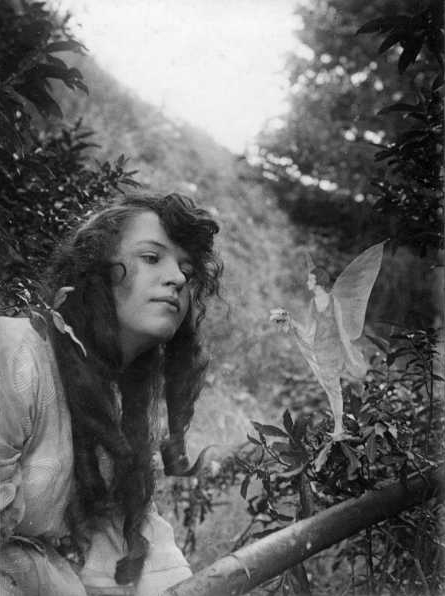
He thus he became one of the many Victorian "Fairy Painters" who popularised the subject at the very time the interest in the supernatural was growing - which led to the ultimate hoax, "The Cottingley Fairies", when two cousins tricked the intelligentsia of the day with photographs of these supposed winged sprites. 

Thus we have three degrees of separation from the Wallace Tower to the Cottingley Fairies. History is always under your feet and on your doorstep!!

"Fake" Fairy photo with Elsie, one of the tricky cousins and her fairy friend


Wednesday, 3 October 2012

Let folk say what they please!

That was the gist of the motto of the Earls Marischal, the Keith family, the full version being Ne'er ye mind fit folk say, dee ye weel and lat them say.  Only, that is a variant of the motto displayed in Marischal College's Mitchell Hall.  George Keith, the Protestant 5th earl, founded the college in 1593 as a rival to Catholic noble, Alexander Fraser's university college in Fraserburgh, founded but a year before.  George and his uncle, William Keith, the 4th earl, had basically stitched up a whole list of monastic properties between them, including the Earl's Hall in Castlegate which had been the Abbot of Deer's house.  Greyfriars was where Marischal was built; the Blackfriars/Dominicans' old estate was also claimed by the Keiths.

The family appear to have Anglo-Norman origins as many of the 13th century nobles did.  One Harvey de Keth saved the life of William the Lion, King of Scots and was awarded the title of "Great Marischal", the duties of which included being the royal bodyguard at court, and keeper of the royal regalia.  Their earldom was awarded in 1458.  They married into another settled Anglo-Norman family, the Cheynes of Inverugie, which allowed them to own both Ravenscraig and Inverugie castles situated on the river which flowed into Peterhead, one of the Keiths' major seats of power.  That allied them to Bishop Henry Cheyne of St Machar - the priest whose support for the usurped John Balliol and the Comyns brought him into conflict with Robert the Bruce.  Henry's brother, Reginald, was the one who invited the Carmelites to come to Aberdeen in 1270.  So they were well-connected even then!

After the Reformation church lands were fair game for any noble of the old or new religions; William Keith was smart, he, with royal favour, had his son Robert created "Commendator of Deer" - this meant that he was the postulant bishop - a trainee - even though he probably had no intention of following a religious life when his Dad was a Protestant!  By the time poor Mary, Queen of Scots had lost her life and her son James, VI of Scotland was on the throne, being a Catholic was very unwise.  The Keiths ingratiated themselves to the new king, and in a smart deal, resigned the lands of Deer to the crown in exchange for two things - for Robert, the Lordship of Altrie, and for his cousin George, who would be William's heir, a burgh of barony which included all the lands which belonged to the Abbey of Deer and the town of Peterhead.

Talk about sticking two fingers up at everyone else! No wonder they had such a motto!

Now the oddity in today's blog post is the fact that the version of the motto I quoted earlier is etched into a block on a wall in Jackson Terrace.  There is no earthly reason why it should be there! The land where these Victorian tenements stand was empty waste ground until at least the 1800s.  King Street wasn't started until 1808!  Where did this block come from? And why did it end up in a tenement building which backed onto the old King Street school?  If anyone has any ideas, let me know!!