Showing posts with label Denburn. Show all posts

Saturday, 16 July 2011

Well, well, well!

Three holes in the ground!  Yes, the standard retort to repeating the word 'well'.  But in this case, the QI elves of Aberdeen refer to the shifting site of the once beautiful Spa Well, praised by none less than the king's physician, Dr Gilbert Skene in his 1580 pamphlet "Ane Brief Descriptioun of the Qualiteis and Effectis of the Well of the Woman Hill" (a later facsimile of this work dated 1884 claims that it is not the work of Dr Skene, but someone with only second-hand knowledge of the well), and recognised for its curative qualities as a source of iron mineral salts or 'chalybeate' water.

Spa Street today - the well would have been on the left, just where the cyclist is crossing
The Well of Spa was situated where the entrance to the Upper Denburn car park is now.  The car park forms the lower part of the Denburn Health Centre which was built in the early 1970s, cutting off Jack's Brae and Hardweird from the rest of the Gilcomston area.  Good water sources were difficult to come by in medieval times - too many folk were washing their clothes in the great Loch of Aberdeen - which covered a large area from Loch St near Aberdeen College to Maberley St where the remains of Richards' Mill stands today - and causing it to become 'filthy and defilet' as a 17th century report claimed.  The Spa Well represented the main public water source for the Denburn and Gilcomston area.

Spring wells were made accessible to the public by the construction of well-houses, which usually contained a spout or tap and cups to ease drinking from.  Water, nicknamed Adam's Wine by some, was so vital in an age where a settled population had forgotten all their Neolithic and Mesolithic ancestors knew about cleanliness and good ground.  What had filtered through was a continuing superstitious veneration of water, long after the Reformation had supposedly done away with 'Popish' fancies, and many 'Holy Wells' still existed.  The Holy Wells of Catholic Scotland may also have derived from the magically-endowed waters of wells and springs that Pagan Celts, Picts and Neolithic folk would have worshipped - it's what you call spiritual archaeology!  Even the name of the River Dee recalls both the Latin word for a goddess - Dea, indicating the Romans worshipped water and river spirits also.

So why is there a link between water worship and the Spa Well?

The spirits or angels who inhabited or blessed the wells and water courses were relied upon for healing.  The Pool of Bethesda, or Five Porched Pool mentioned in John's Gospel carried a legend that an angel touched the water at a certain time and the first to enter the pool would  be cured of whatever ailment from which they suffered.  It is no surprise then that we read of the Spa Well's earliest description (1615) as having "a long wide stone which conveyed the waters from the spring, with the portraiture of six Apostles hewn upon either side thereof."

This 12th century carving of the Apostles may provide some idea as to the design of the Spa Well's original housing

Also, the mineral qualities of the spring water had been recognised as a curative measure for a number of conditions in medieval times which physicians found hard to treat otherwise.  Dudley North found this to be the case with the chalybeate spring at Tunbridge Wells, and his doctor claimed that Baron North's discovery meant a cure for the following:
  • colic
  • the melancholy
  • the vapours
  • flat worms in the belly
  • clammy humours
  • 'over-moist brain'
Queen Victoria would later discover the pleasure of Tunbridge Wells, and bestow upon it regal approval, giving the citizens the right to call it Royal Tunbridge Wells.

Other physicians claimed it cured hysteria.
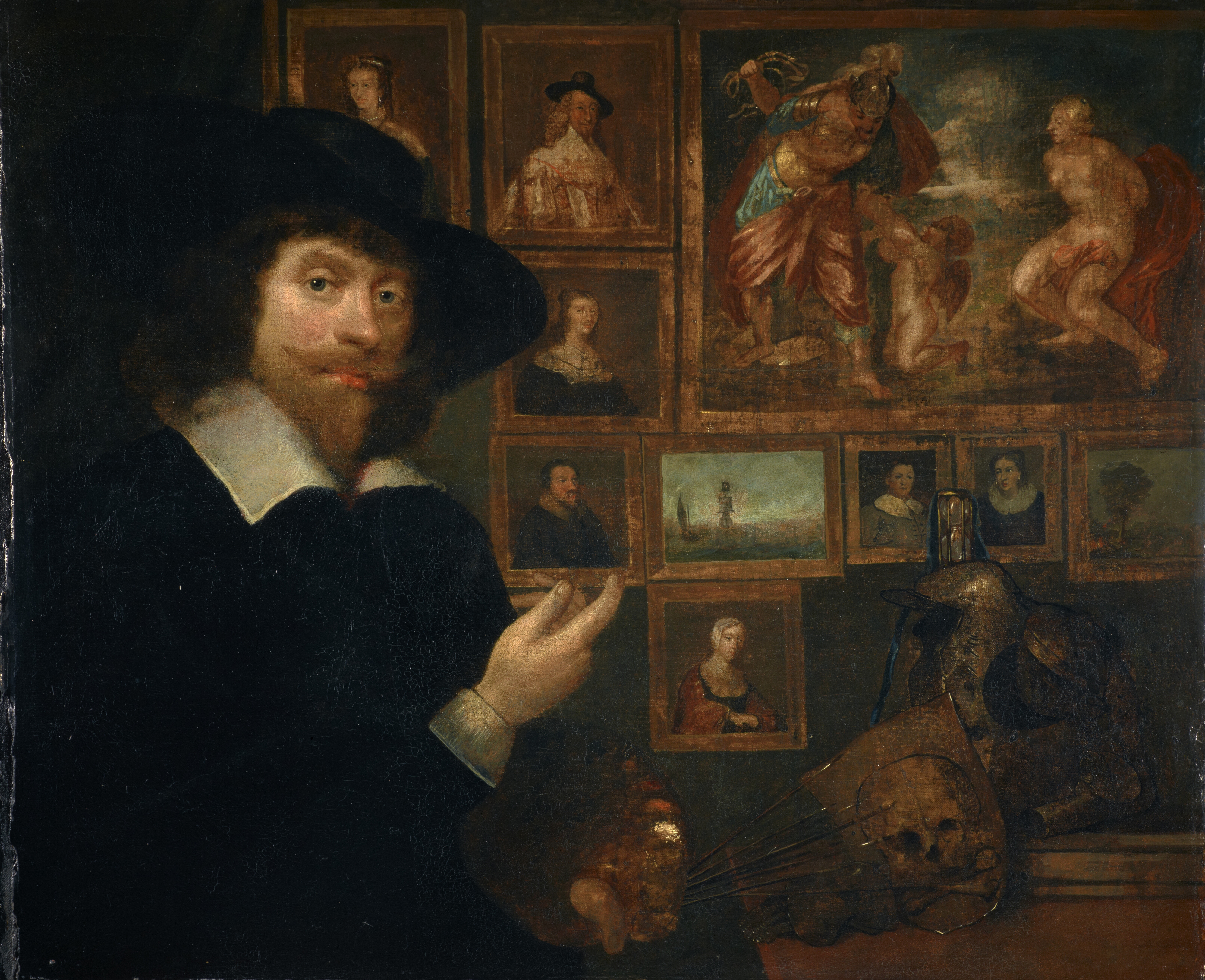
George Jameson - self portrait 1642 (Scot. Nat. Gall)
Our Spa well cured a certain George Jameson of bladder stones, much to his relief and delight, one would imagine!  George was the son of Aberdeen master mason, Andrew Jameson; he himself was known as the Scottish Van Dyck, being one of this country's earliest portrait painters.  His only surviving child, Mary, would turn out to be as skilled with a needle and thread as her dad was with a paintbrush, or her grandfather with a hammer and chisel - her tapestry work can be seen on display in St. Nicholas Kirk to this day.


George's delight at being cured resulted in him requesting of the council the opportunity to renew the well and create a new garden for his own and others' enjoyment on the bank of the Denburn in 1635.  He also either renewed or created the Playe Green which stood where Woolmanhill hospital does today, a space for travelling players to perform - medieval mystery plays were still very popular as were productions of contemporary works, and this site outside the city boundary (yet within the Celtic domain of Gillecoaim, the chief who gave his name to Gilcomston) was ideal for companies arriving by boat or from the south over the Bow Brig.  There are again suggestions that Jameson had nothing to do with the well house as it stood at the top of the Garden Nook he built, but it is more likely that he did, having a master mason for a father, and he was back from Holland and established in his Schoolhill house for 25 years by this time.

The sandstone well house which still exists today bears Jameson's gleeful inscription:
as Heaven gives me, so I give thee


The Four Neuked Garden or Garden-Nook as it appears on later maps was certainly in existence when James Gordon published his map of Aberdeen in 1661 - it remained until 1867, shown clearly on the OS map as sited behind the well house and its sunken circular seating.  There is no mention of the garden by 1912 in the area shown on Bartholomew's map, and its old neighbour, the Gilcomston Brewery had gone by then also.

OS Map Copyright 

The well itself seemed to have survived as the water supply until 1860.  Just a few decades after Jameson's attentions, Baillie Alexander Skene also requested funds to renew the well house in 1670, writing that a new well house was required as "these severall yeires bygone, since the same wes stopit by the violent torrent of wateris which overturned it." It seems the Denburn was prone to flooding, as was perhaps the Gilcomston burn, not far hence, and had damaged the well house.  This was prior to the installation of the plumbing for a universal water supply in the early 1700s for Aberdeen, so Skene was granted his wish - perhaps the canny cooncillors recognising the wisdom of his words concerning the Spa Well's tourist potential! "Those seeklie [sickly] strangeris knowning of such ane free offer of health might make more frequent resort to this burghe"

The well house then receives a new inscription to remind all of the council's generosity: Hoc fonte derivita salus in patriam populunque fliat / May health derived from this spring flow to country and people (Spada Rediviva 1670)

Both the early inscriptions are in the sandstone, which have lead some historians to date the well house from that period, indicating that Jameson may have had the original stone panels with the apostles still on them renewed, some even say Skene made mention of these panels.  Sandstone was the popular building material in the city right through medieval times until the commercial working of granite came into being.  Old Red Sandstone, which lies in the land to the north and south of Aberdeen, was softer and easier to work - some of Andrew Jameson's handiwork can be seen in Provost Ross's house in the Shiprow - so granite was hardly used unless in the form of freestone, i.e., unworked lumps as would be found in a dry stane wall.

Spa Well House in its Regency Setting (Wyness)

Another clue appears in the last inscription which is carved into a block of granite, its grey, hard surface very different to the still crumbly sandstone - reading The work was renewed in 1851.  Enter the Police Commissioners - instituted 1798, the burgh police constabulary to come in 1818 - who find the well is in a bad state of repair and the spring is being diverted by rubble and stones in the burn itself.  The work is done to culvert the burn to protect it from further pollution and the well house most likely re-plumbed.


The well house remains on site until 1893 when it is removed to the hospital side of the road, and re-plumbed again, it being no longer considered a salubrious place to visit.  Fenton Wyness' book 'Aberdeen - A Century of Change' shows an image of the well house in its new spot.

Spa Well in its Edwardian setting - the back wall still exists today
beside the water tank in Woolmanhill Hospital grounds (Wyness)
In 1882 a chemical survey of the well had been carried out by a Thomas Jameson who was able to show its source was the Gilcomston Burn, as the mineral content was identical to a well at Gilcomston Steps, then across from the 'Rotten Holes' the local name for the apprentices' accommodation next to the Broadford Mill.  The water flow had been interrupted by the railway workings in the Denburn Valley, which disrupted both the early streams which had fed into the Loch and others like the Mautmill Burn, the Putachie Burn, all of which eventually emptied into the harbour.

Most of Aberdeen's wells disappeared with new water sources and drainage, few even daring to drink what was now thought to be polluted.

Our friend the Spa Well was no exception - shifted again in 1977 when the new health centre swept away old Upper Denburn forever, and left high and dry, it sits today in a 'pocket park' with a little circular wall reminiscent of the 17th century one, as a curious landmark of the past.


The sun symbol takes us right back to the spring's Pagan ancestry, where the Sun god was the giver of all life, and hence the giver of water too - and the rose, thistle and fleur-de-lis a reminder of Aberdeen's Jacobite sympathies - the 'little white rose of Scotland' that Hugh MacDiarmid said "smells sharp and sweet and breaks the heart" - the prickly thistle declaring "wha daur meddle wi me?" and the lily-flower, symbol of France, the auld ally, but even earlier still, the lily was the flower of the Virgin Mary, the symbol that appeared on the arms of Old Aberdeen and Kings College, and thus a Catholic icon.

The well cured, but no cure found for itself... so if you wander past it one day, give its roof a wee *clappie and say 'Well, well, well..."

*clap (v.) Scots - to pat affectionately; clappie - diminutive of.

images copyright to Fiona-Jane Brown; unless stated; 

Wednesday, 15 June 2011

Inspecting the Castle Spectre

No's 4-5 Mackie Place  c. 1880s - image copyright, Ron Winram

No's 4-5 Mackie Place 2011 - image copyright FJB

Mackie Place, you ask, far's that?  An anonymous little cul-de-sac off Skene Street which got its name from hide-skinner Robert Mackie, who owned the land and rented it out during the late 1700s, making him a 'bunnet laird', i.e. a minor landlord.  He was friends with John Jack, manufacturer who owned the land which was named Jack's Brae and Hardweird.

Mackie Place is odd though, if not for its eccentric architecture, then for its bohemian former residents!

Maybe it was because the Denburn flowed freely through the area that they believed they were a little enclave of free thinkers, but the folk who lived in 'The Galleries', no. 6, Mackie Place, which is now no more, certainly liked to have fun both intellectually and and childishly.


The White House - Mackie Place

G.M. Fraser in his Aberdeen Place Names suggests that 'Galleries' is the corruption of the Gaelic for 'the hollow of the flowing water' which indeed it is, and since the Celts more often than not named places for their topographic description, it is very likely this is true.  Enter the Forbes family (probably pronounced 'For-bez'), a gang of clever, but eccentric, and probably Romantic Edwardians who lived in the Galleries.  They had their own printing press called The Mackie Place Company, which produced a monthly periodical for twelve years called The Castle Spectre.

Why this name? One, the Forbes' house was harled, thus it shone white in sun and moon light, and perhaps gave rise to the name of another neighbouring street 'Whitehouse Street' as it was so prominent at the time, and was rumoured to be haunted.  Standing five storeys tall with its curious 'ogee' or 's' shaped gable, which is reflected in the smaller building which are the remaining properties no.'s 4 and 5 Mackie Place, it's no wonder local residents thought it a tad spooky!

Two - 18th century Gothic novelist, Matthew Lewis had written a play called The Castle Spectre in 1796.  Although more famous for his horror novel The Monk, the play wasn't well-received.  Literary Gothic, which includes the likes of Frankenstein and Dracula was like marmite, you either loved it or hated it!  The Spectre in question is the ghost of the castle heiress's murdered mother - the girl, Lady Angela, is being held captive and forced into marrying her uncle (no concern about incest then?), while her boyfriend, Sir Osmond is trying to attack the castle and free her, meanwhile, the ghostly mother is hanging about trying to protect her daughter.  Fantastically melodramatic plot!  No wonder Jane Austen thought she'd have a go at a pastiche of the Gothic style in her spoof novel Northanger Abbey.

The Forbes family would probably have been fans of Mr 'Monk' Lewis, as the stories, poems and epigrams were perhaps of that romanticised, we might say mawkish type.  If you want to check, G. M. Fraser, who was the city librarian, mentions that the collected volume of the Spectre is in the Central Library archives!!

The family and their literary friends, many quite young children, would enjoy themselves on dark nights by dressing in sheets, sticking scary-faced neep lanterns with candles therein along the walls and in the hedges, and generally jumping oot at passers by with loud whoops and wails like the chorus of the damned.  They were only keeping up the reputation of the White House after all.  The Forbes' obviously were tenants of Robert Mackie as Ron Winram mentions in Walkin the Mat that the town watchman daurna gaun further than the foot of Jack's Brae on nightly duties - the 'Night Watch' was the beginning of Aberdeen City's police force and began in 1818, helping us to date the activities of the inhabitants of The Galleries.

To get back to the houses - both the Galleries and no.'s 4-5 were built after 1760, and apparently bore a strong similarity with Raeden House which used to stand near Westburn Road (before the road was built and it was Midstocket!).  There were no houses round about in those days - Skene Place wasn't built, either was Esslemont Avenue, you were practically in the countryside if you lived there, and once the Bridewell or West Prison was built in nearby Rose Street, it wasn't somewhere to be wandering at night for fear of escapees!  The peaceful wee hideyhole on the Denburn would still have been a haven of luxury for the literary set of the White House.

So if you go walking along towards the Grammar School, pass in front of Skene Place, the large block of 19th century tenements, and look for the little stone dyke, turn down and cross the bridge into a time warp of the days when the Prince Regent was running Britain, the mad old King George was at his last, and a set of intellectuals could find their verses quite happily received by others lovers of poetry and prose.

I finish with a verse from Miss Forbes, the daughter of the family:

 Beneath two giant willows that stand before our door
 The Denburn runs so sweetly with its green and silvery shore
 But sometimes it is flooded and then then torrent's roar
 Is like the sound near Buffaloe where hearing is no more
 When down comes sticks and turnips and tumbles down the wall
 Oh! what a hurry scurry when you think the bridge will fall!